
The Growing Labor Movement Around Workplace Heat
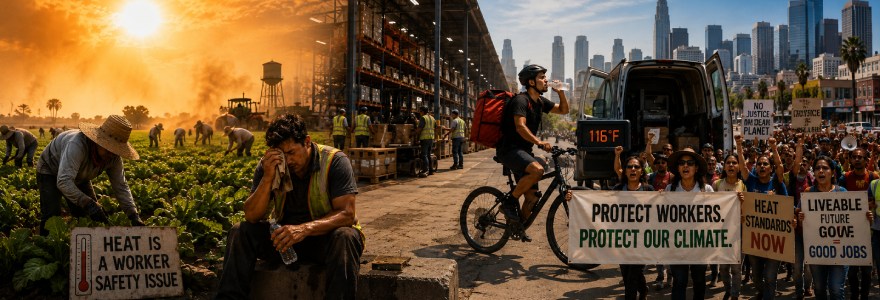
Extreme heat is now killing and injuring workers at a rate that outpaces most other occupational hazards, and the numbers are almost certainly undercounted. For farmworkers stooped over crops in the Central Valley, warehouse staff inside steel-roofed facilities with no air conditioning, and delivery drivers cycling in and out of un-cooled vehicles, the workplace has become one of the most dangerous places to be during a heat event. This convergence of climate risk and labor vulnerability has pushed heat to the center of a growing organizing movement – one that is demanding federal protections, employer accountability, and recognition that what happens on a job site is inseparable from what is happening to the climate.
Why Extreme Heat Has Become a Workplace Crisis
Across the United States, workers are getting sick, losing wages, and dying at rates that researchers now directly link to rising ambient temperatures. The Bureau of Labor Statistics recorded 436 occupational heat fatalities in 2021 alone, a figure widely considered an undercount because heat stress is routinely misclassified as cardiac arrest or dehydration on death certificates.
The mechanics are straightforward, even if the toll is not. When air temperatures climb above 90°F and humidity reduces the body’s ability to sweat effectively, core temperature rises. Outdoor workers face direct solar radiation on top of that. Inside warehouses, commercial kitchens, and manufacturing plants, heat builds throughout a shift with no natural wind to cut it. Workers in these environments often cannot slow their pace to compensate. Productivity quotas, piece-rate pay structures, and informal pressure from supervisors mean that taking an extra break can cost income or a job.
Access to shade, cool water, and rest intervals remains inconsistent and often inadequate. The Occupational Safety and Health Administration still has no federal heat standard, leaving protections largely to state discretion and employer goodwill. Dr. Juanita Constible of the Natural Resources Defense Council has noted that heat is the leading weather-related killer in the country, yet workers in agriculture, construction, and logistics remain among the least protected.
Climate projections make this worse. The number of days per year exceeding dangerous heat thresholds is expected to double in many regions by 2050, concentrating the burden on workers who cannot simply move indoors.
Heat Exposure Follows Lines of Labor, Race, and Inequality
Who endures the heat? Hardly a matter of chance. Among workers most exposed to dangerous heat in the U. S., Latinos, African Americans, Indigenous, and immigrant communities are heavily overrepresented, as they and other working families are in agriculture, construction, warehouses, and delivery – all of which don’t have much shade and may or may not have air conditioning (usually reserved for management offices only).
A farmworker is perhaps the most striking case. Paid by volume or by piece, these workers have no time away from sun, as they work for 8-12 hours every single day of the seven-day workweek with only short breaks now and then, which exist at the complete discretion of the employer. If you rest from heat for just one second, you will lose dollars. OSHA at the federal level still does not have a permanent heat standard; hence, employers don’t have a reason as a matter of law to provide water, rest, and shade. California passed emergency standards in the wake of farmworker deaths in the early 2000s, but enforcement has been very poor, complaints are rarely filed by undocumented workers, who mostly fear real deportation proceedings.
Warehouse workers have a different take on the same problem of punishing conditions. In summer months, the average temperature in the shipping facilities run by some top logistics companies lingers around 90 to 100 degrees, enforced with quotas for productivity that punish slowing down due to heat conditions. Levels of insulation for multinationals increase at the step of subcontracting: employment of workers by the staffing agency means less legal obligation on traceable brands sitting atop the chain.
Children living in remote locations feel the brunt unseen by any; even those groups where heat strokes are liable to be killed. For years, the prisons in Southern states have been void of air conditioning; severe disciplinary actions, and periodic non-answers, follow the incident of dying to heat stroke among the prisoners on outside labor detail. The entire trajectory of heat risk distribution seems to be deeply correlated with the disempowerment of workers.
How Workers Are Turning Heat Into a Climate Organizing Issue
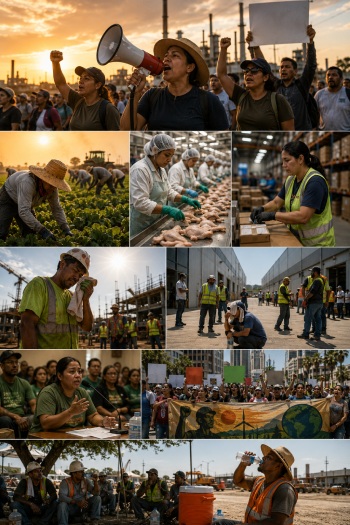
Something shifted when poultry workers in Delmarva, agricultural laborers in California’s Central Valley, and warehouse employees in Phoenix started comparing notes. Their grievances – dizziness on the line, no shade breaks, supervisors dismissing heat complaints – sounded identical. That recognition is now driving a convergence of unions, worker centers, environmental justice organizations, and climate groups that few anticipated five years ago.
For decades, heat on the job was treated as an isolated occupational hazard, a matter for OSHA compliance officers rather than climate advocates. Organizers have since reframed it deliberately. Rising temperatures are not background noise; they are a direct consequence of fossil fuel emissions landing hardest on workers who already face wage theft, inadequate healthcare, and little political power. That reframe matters strategically, because it connects workplace safety demands to the broader climate justice movement and expands the coalition fighting for both.
Concrete campaigns illustrate the shift. In 2021, United Farm Workers helped push California to adopt emergency heat regulations for agricultural workers, backed by testimony from farmworkers who described collapsing in fields and being told to keep picking. Warehouse workers at Amazon facilities in Inland Empire, California, organized walkouts in 2022 explicitly citing heat and linked those actions to climate accountability campaigns targeting the company’s emissions record.
Bargaining tables are changing too. Unions in sectors from construction to food processing are negotiating heat provisions – mandatory rest breaks, cooling stations, right to refuse unsafe conditions – as standard contract language rather than afterthoughts. Organizers are pairing worker testimony with local temperature data, making lived experience and climate science mutually reinforcing arguments in public hearings and legislative chambers.
The Fight for Heat Protections Will Shape Climate Justice
Physical safety standards, worker empowerment, and public investment are not local demands; such elements are at the heart of what would seriously adjust to climate. Indeed, farmworkers collapsing in the Central Valley of California, warehouse workers at the Texas distribution centers denying themselves sips of water, and construction crews laboring through triple-degree temperatures without a legally imposed rest period embody the vivid face of the real-world bodies that have to actually bear the physical cost of a temperate world and are not yet afforded any legal protections against it. The most penalized workers are the most financially underprivileged, Latino, black, and immigrant workers on the whole, better positioned for bad politics and with the most on the line.
It is true that, historically undertaken, climate policy has top-to-bottom positions with adaptation secured on the lower strata while emissions reduction has remained on top. Heat standards mess up this hierarchy at its core level. When workers finally come by shelter, water, and shelter breaks-and much more-than the right fight and the fittings go into law and are enforced, it signifies that adaptation projects could throw comfort around their most vulnerable rather than putting investment on the backbones of the least vulnerable. The moral and political test that workplace heat throws before society is rather whether governments, businesses, and global movements will rise together to consensually support this weather. This will, in the long run, form the real-life working definition of climate justice.